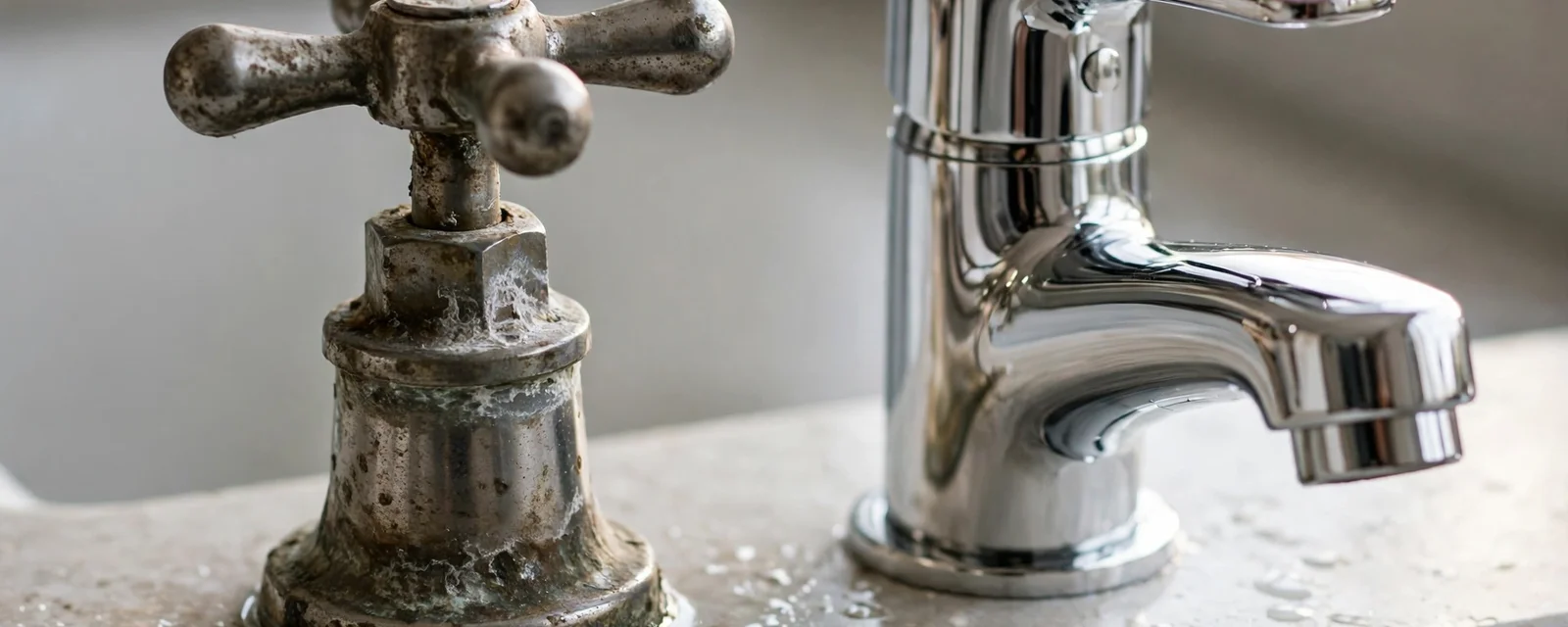
Your decision table
| What you notice | Lean toward | Why |
|---|---|---|
| Faucet is fairly new and drips from the spout | Repair | A cartridge or washer is a small, cheap part on a fixture that has life left |
| Finish is flaking, pitted or green at the joints | Replace | Surface damage means the metal is failing, not just a seal |
| Handle wobbles and the base leaks | Replace | The mounting and body wear is deeper than a seal change |
| Low flow from only one faucet | Repair | The aerator or cartridge is often clogged, not the whole faucet |
| Parts for your brand or model are unavailable | Replace | A repair without parts is a delay |
| Same faucet has leaked twice in a year | Replace | The cost of a third repair buys most of a new faucet |
| Water under the sink only when the faucet is on | Inspect first | Could be the supply line or the faucet body |
| You are changing the countertop or sink | Replace | Access is open, and a new fixture makes sense |
Four signs that say replace, not repair
Corrosion
Crusty buildup, green or white deposits and a rough finish suggest the fixture is wearing out from the inside.
Obsolete parts
If the cartridge is discontinued or sold only by the maker at a high markup, a new faucet is easier.
Repeat leaks
A faucet that drips again soon after a repair often has a worn seat or body that a new cartridge will not fix.
Style or function change
If you want a pull-down sprayer, touchless control or a different height, a swap solves it.
Cost matters, but so does time. A repair that takes twenty minutes and a small part is an easy yes, while a third visit for the same fixture is usually a sign to stop.
When repair is the right call
A newer faucet with a slow drip or a stiff handle often needs only a cartridge, an O-ring or an aerator clean. If the finish is good and the base is tight, a small repair can give years of use.
Repair also makes sense when you like the fixture, it is a quality brand with parts on the shelf, and the countertop or sink would make a swap hard. Our faucet repair team starts by finding which part has failed and tells you if replacement would be wiser.
One quick check before you decide
Dry the cabinet floor, then run the faucet for a minute with a dry paper towel at the supply connections and the drain. If the faucet body is dry and the connections are wet, you are not looking at a faucet problem at all.
If you are unsure after the table, take two photos: the full faucet and the underside of the sink. A plumber can often tell from those whether the fixture is worth saving, and the answer may save you a trip to the store.
What a swap involves
Shut off and disconnect
Close the shutoff valves, open the faucet to drain, and disconnect the supply lines from the old fixture.
Remove the old faucet
Loosen the mounting nuts under the sink, a tight job in many cabinets, and lift the faucet out. Clean the deck.
Mount the new faucet
Seat it on its gasket, tighten the mounting hardware from below and connect any sprayer hose.
Connect supply lines and test
Attach new supply lines, open the shutoffs slowly, flush the line and check every joint for moisture.
Winslow context for the repair or replace question
Township guidance links a higher water bill to undetected leaks. A faucet that drips overnight while you are away is a small but constant source, and it is one reason not to leave a failing fixture for later. Check the toilets and shower heads too, which the Township names as common leak points.
Per the Department of Municipal Utilities (609-567-0700), Township water starts in wells tapping three aquifers and is topped up through New Jersey American Water. The water quality report carries no hardness figure, so test your tap to see whether mineral deposits are clogging your aerator and cartridge. The DMU can send the annual report.
The Construction Office (609-567-0700, option 5) decides what permit rules apply to plumbing in the Township. A like-for-like fixture swap is typically small, but ask rather than assume. State law reserves the work for licensed plumbing contractors and their employees.
Want a straight answer on your faucet?
Call and describe what you see. Same-day appointments are offered when available, and the plumber quotes a clear price before work starts, whether you repair or replace.
What drives the repair versus replace bill
The lowest first number is not always the lowest total. Compare these items.
Coverage typically follows sudden damage rather than wear or neglect. A worn faucet is your maintenance cost, though a burst supply line that floods the kitchen may be a covered event. Check with your carrier.
Whether you live in Sicklerville (08081), Winslow (08095), Cedar Brook (08018) or West Atco (08004), the decision logic is the same: fix what is sound and replace what is failing. Plumbers also work with new sink and countertop installs through our plumbing installation service. We dispatch to Gloucester Township and Monroe Township as well.
Questions Winslow homeowners ask
If the body is sound, the finish is good and parts are available, repair is usually reasonable. If it is corroded, leaks at the base or has been repaired repeatedly, replacement is the better value.
It varies by quality and water conditions. Ask the maker for the stated service life, and treat repeat leaks and corrosion as signs the faucet is near the end.
A single worn part is usually cheaper to repair. A corroded or repeatedly failing faucet costs more over time, and replacement can be the lower total.
The Township's water quality report does not publish a hardness figure, so we cannot say. Test your tap and ask the Department of Municipal Utilities for the annual report to see if mineral buildup is a factor.
The Construction Office decides what applies and can be reached at 609-567-0700, option 5. Ask before the work starts.
Yes. Supply lines, shutoff valves and drain connections all leak into the same cabinet. Dry each connection and see which one gets wet first.
Sources and standards
Facts on this page come from these public sources. Check local rules with the office named in each.