Do you need a sump pump or a different fix?
A sump pump only helps when water is coming up through the floor or the floor-to-wall joint. If water is dripping from a pipe, running down a wall after rain from a bad gutter, or showing up from a failed window well, a pit and pump will not fix the source.
Look at the pattern. Water that appears days after a long rain, then drains away slowly, points to a high water table. Water that appears within minutes of a downspout discharging points to surface drainage, and moving the downspout may cost far less than a pump.
- Damp floor along the same wall after every heavy rain
- Standing water in the lowest corner that returns after you mop it
- A musty smell in a finished basement that gets worse in spring
- Efflorescence, the white crust, on block or poured walls
Why the water table matters in Winslow
In an area fed by a shallow water-table aquifer, groundwater rises and falls with the weather. That is why one wet week can turn a dry basement into a wet one, and why a house with no history of water can suddenly need a pump after a rainy fall.
| Type | How it works | Best fit | Watch for |
|---|---|---|---|
| Submersible | Sits inside the pit, sealed motor, quiet | Most finished basements | Needs a pit deep enough to keep it covered |
| Pedestal | Motor sits above the pit on a stand | Tight pits, easy access for service | Louder, motor can be reached by children |
| Battery backup | Second pump powered by a battery when the grid fails | Homes that lose power in storms | Battery needs testing and replacement over time |
| Water-powered backup | Runs off household water pressure | Homes on municipal water with no battery space | Uses water, and only works with enough pressure |
| Combination primary and backup | Two pumps in one pit with separate switches | Basements where a flood would be costly | Larger pit and more electrical planning |
What a sump pump installation involves, step by step
Find the low point
The plumber checks where water actually enters, then picks the pit location. The low corner is common, but a pit near the entry point often works better.
Cut the floor and dig the pit
The slab is cut, the soil removed and a liner set. Concrete dust and debris are part of this step, so expect the area to be covered and cleared.
Set the pump and check valve
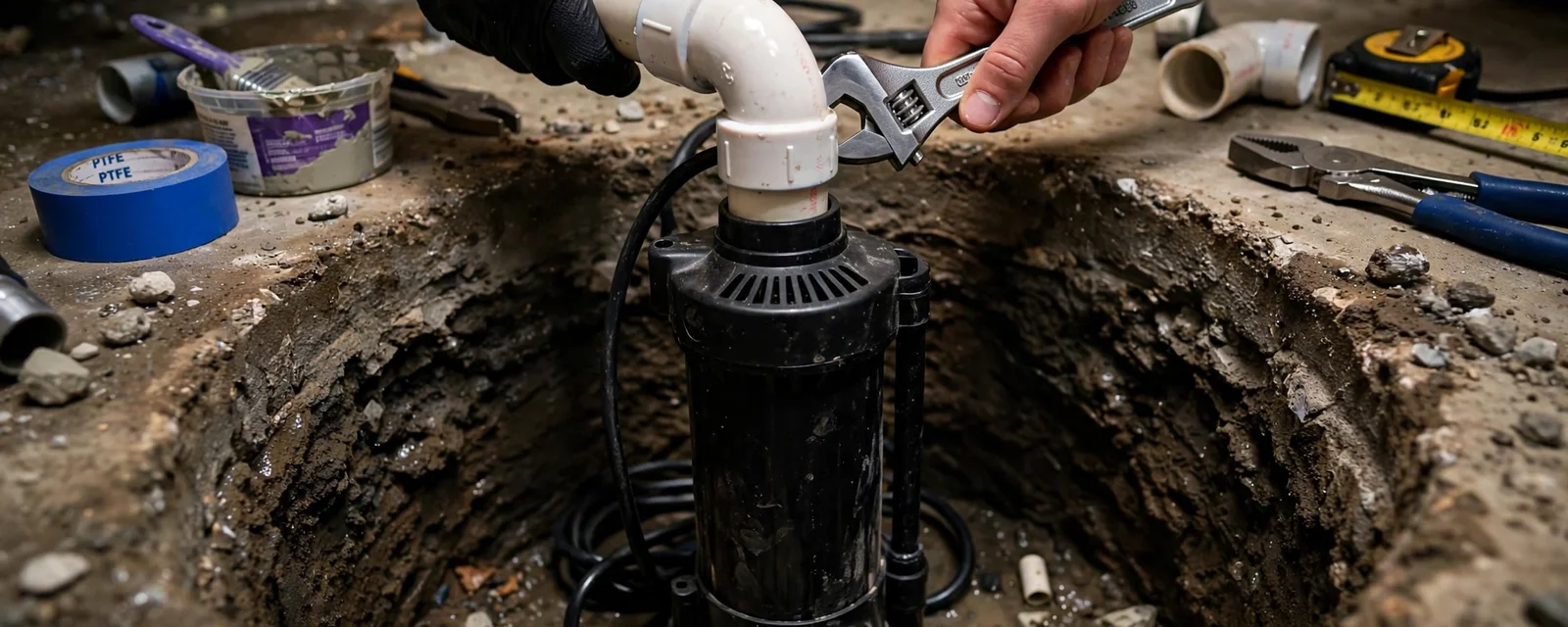
The pump goes in on a firm base. A check valve on the discharge line stops water from running back into the pit each time the pump stops.
Run the discharge line
The pipe leaves the house through the rim joist or wall and ends where the water will not circle back to the foundation. It should not feed a neighbor's yard or a sewer line.
Power and test
The pump needs its own outlet with ground-fault protection, installed by a licensed electrician if one is not there. The plumber then fills the pit with water to confirm the float switch and discharge work.
Never connect a sump pump to the sanitary sewer drain. Clean groundwater sent into a sewer line adds load that the sewer system is not built to take, and the connection can also let sewer gas and backups into the pit. If your house has an old connection like that, a plumber can explain safer options.
What Winslow homeowners should know before they dig
New Jersey's Department of Environmental Protection describes the Township's water source as a Kirkwood-Cohansey watertable aquifer system. A water-table aquifer is unconfined, so its level follows rainfall. For a basement, that means seasonal swings are normal, and a pump sized for a wet spring matters more than one sized for a dry August.
Permit rules vary by job, so ask the Winslow Township Construction Office before work starts. You can reach it at 609-567-0700, option 5, or construction@winslowtownship.com, with office hours of 8:30 to 4:30. Inspectors do plumbing work Tuesday to Thursday from 8am to 1pm, so any inspection falls in that window.
The state's plumbing subcode is the 2021 edition of the National Standard Plumbing Code Illustrated, adopted at N.J.A.C. 5:23-3.15. State law limits the work to a master plumber, an authorized plumbing contractor or W-2 employees of one, so ask for the license number and look it up with the State Board of Examiners of Master Plumbers.
Plumber, electrician or waterproofing contractor?
A plumber handles the pit, pump, check valve and discharge pipe, and new fixtures fall under general plumbing installation. An electrician is needed for a new circuit or a ground-fault outlet. A waterproofing contractor works on the wall, the footing drain and exterior grading, which is a separate scope.
If you already have interior drain tile and a pit that floods, a sump pump service visit may be all you need. If the water enters through a cracked wall, tell the plumber, because a pump can lower the water level but will not seal a crack.
Basement taking on water now?
Move valuables off the floor and keep away from outlets and cords near standing water. Our 24/7 dispatch can send a licensed plumber to talk through a pump.
What changes the price of a sump pump job
Cost factors to compare between quotes
Prices depend on the house, so ask each plumber what is included. These are the items that move a quote up or down.
Homeowners insurance typically responds to sudden damage and not to wear or neglect, and water that seeps up from the ground is often excluded. Ask your carrier what your policy covers before you rely on it.
Maintenance after the install
Test the pump twice a year. Pour a bucket of water into the pit and watch the float rise, the pump start and the water leave. Check that the discharge pipe outlet is clear of leaves, snow and ice.
If you use a battery backup, check its date and test it on a schedule the maker recommends. A pump that runs constantly, runs without water or short-cycles every few seconds needs a service visit, since the float, check valve or sizing may be wrong.
Homes in Sicklerville (08081) and Cedar Brook (08018) were built on different lots with different grading, so your neighbor's pump setup may not suit your house. Ask for a site check rather than a copy of someone else's job. Nearby towns such as Berlin Borough and Hammonton sit in the same wider region, and we dispatch there too.
Questions Winslow homeowners ask
Many installs finish in one day when the floor is open and a grounded outlet is nearby. Finished basements, thick slabs, a long discharge run or new electrical work can stretch it out.
Swapping a pump in an existing pit is a common DIY job. Cutting a new pit, running a discharge line and adding electrical power are different. Because the pump sits in water, ground-fault protection is essential, and a licensed plumber and electrician should do the new work.
Permit rules vary by scope, and the Construction Office decides. Call 609-567-0700, option 5, before work starts so you know whether a permit and inspection apply to your job.
Winslow draws its water from a Kirkwood-Cohansey water-table system, which is an unconfined aquifer whose levels follow rainfall. After a wet stretch the groundwater can rise toward a foundation that was dry in a drier year.
If a flooded basement would be costly and your power drops in storms, a backup is worth pricing. A battery or water-powered unit keeps the pit pumping when the main pump or the grid fails.
Away from the foundation, off your neighbor's property and out of the sanitary sewer. Ask the plumber to show you the outlet and confirm water can drain away in freezing weather.
Sources and standards
Facts on this page come from these public sources. Check local rules with the office named in each.