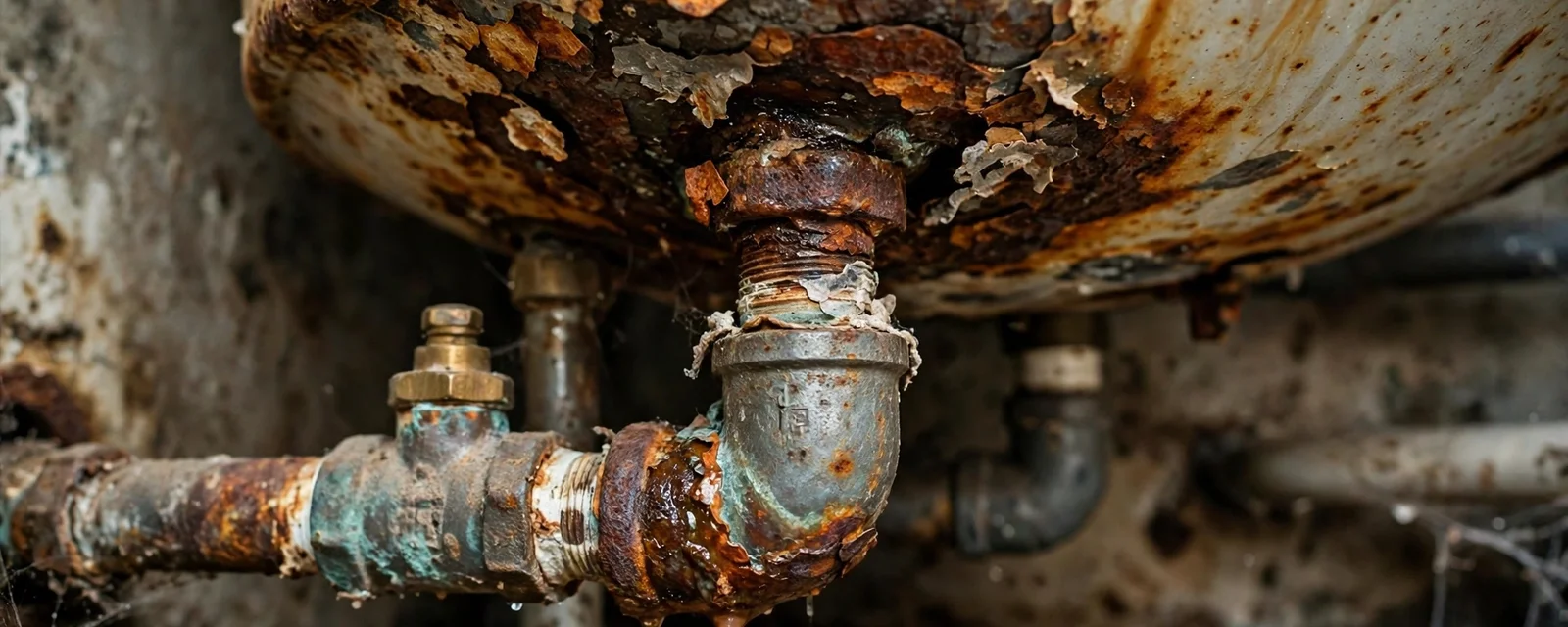
Start with the leak: is it the tank or something attached to it?
Water on the floor is the first thing to sort out, because it decides the whole question. A leak from a fitting, a drain valve, or the temperature and pressure relief valve can often be repaired. A leak from the steel tank itself cannot, since the tank wall cannot be patched.
Turn off the power or gas control and close the cold water valve above the unit before you look. Do not touch wet wiring. If you smell gas, leave the building and call the gas utility or 911 before you call a plumber.
The age check
The U.S. Department of Energy says water heaters typically last about 10 to 15 years. On its comparison, a storage tank lasts 10 to 15 years, a heat pump water heater about 10 to 15, and a tankless unit about 20.
You can read the manufacture date from the serial number on the label, or ask a plumber to decode it.
If your unit is near the end of that range, it is a fair time to price a replacement even if it still works. A repair on a unit with a few years left is easy to justify. A repair on a tank that is already past 15 years may only buy you a season.
A decision table you can use at the heater
| What you see | Usual direction | Why |
|---|---|---|
| No hot water on an electric unit, tank is dry and young | Repair | Often a failed heating element or thermostat, and the tank is fine |
| Pilot or burner will not stay lit on a gas unit | Repair | Often a thermocouple, gas valve, or flame sensor |
| Water leaking at the relief valve or a fitting | Repair first | The part may be at fault, but a hot tank over pressure needs a look at the expansion setup |
| Water pooling under the tank from the tank body | Replace | The tank wall has failed and cannot be patched |
| Rust-colored hot water only, unit over 10 years old | Inspect, likely replace | Rust inside the tank can mean the lining is gone |
| Banging or popping from the tank | Inspect | Sediment buildup, which flushing may help if the tank is sound |
| Unit older than its expected life, several repairs in a row | Replace | Each repair is spent on a unit that is close to done |
| Gas smell near the heater | Leave and call the gas utility or 911 | Safety comes before repair or replace |
What repairs usually cover, and what they do not
Electric units
Heating elements, thermostats, and wiring checks. A plumber cuts the power before opening panels.
Gas units
Thermocouples, pilot assemblies, gas controls, and venting checks. Gas work is done with the gas off and the flue checked.
Relief valve and fittings
Valves and connections can be swapped without replacing the tank.
Anode and flushing
A sound tank with sediment may last longer after a flush and anode check.
A repair does not fix an old tank, and it does not fix a tank that is undersized for the household. If you have been adding a second shower or more people to the house, ask whether the existing size still fits. For repair help, see water heater repair and for full swaps read about water heater replacement.
Standing in a cold shower?
Our dispatch runs 24/7, so call and a licensed plumber can look at the unit and give a clear price before work starts.
If you replace: fuel type and efficiency choices
The Department of Energy lists tankless models as 8 to 34 percent more efficient than storage water heaters. It also says heat pump water heaters can be 2 to 3 times more energy efficient than conventional electric resistance units. Those gains come with different installation needs, so ask what your house requires.
Switching fuel or moving to a tankless unit can mean changes to gas lines, venting, electrical service, or drain routing. A same-fuel swap is usually simpler. Ask the plumber to put the full scope in writing before work starts, so you can compare quotes on the same basis.
What to ask for on any quote
- The repair price and the replacement price, both in writing, side by side.
- The unit's age and how the plumber read it.
- Whether the quote includes a new expansion tank, relief valve, venting, and haul-away.
- The plumber's license number, which you can verify with the State Board of Examiners of Master Plumbers.
- Whether a permit is needed, and who pulls it.
Winslow Township: permits, inspections, and water
New Jersey's plumbing subcode is the National Standard Plumbing Code Illustrated, 2021 edition, adopted at N.J.A.C. 5:23-3.15, and plumbing work must be done by a licensed master plumber or an authorized plumbing contractor.
Permit rules for water heater work vary, so ask the Township Construction Office, which you can reach at 609-567-0700 option 5 or construction@winslowtownship.com. The office says plumbing inspections run Tuesday to Thursday, 8am to 1pm, so plan on that window if an inspection applies.
Practical tie-back: if you hire a plumber, ask who handles the permit question and the inspection. Get the answer before the old unit comes out, not after the new one is in.
Winslow's water comes from wells in the Cohansey and Mount Laurel-Wenonah aquifers plus one in the Piney Point aquifer, and the Township also buys water through an interconnection with New Jersey American Water.
The Township's water quality report does not publish a hardness figure, so test your tap before you assume sediment is a problem. You can ask the Department of Municipal Utilities for the annual water quality report at 609-567-0700.
When repairs are not worth it, and when they are
A repair makes sense when the tank is sound, the unit is within its expected life, and the quote is clearly lower than a replacement.
A replacement makes sense when the tank leaks, rust shows in the hot water, or the unit is past its normal life and has already needed work. The gray zone is a 10 to 12 year old unit with one failed part.
In that gray zone, ask what else the plumber saw. Corroded fittings, a failing anode, or scale on the burner area are all signs the heater may not outlast the repair.
Whether you are in 08081, 08095, or 08018, and whether the house dates to the 1970s Levitt era or is newer, the label on the heater tells the story more than the address does.
If you live near the Waterford or Hammonton line, our coverage includes Waterford Township plumbers and the Hammonton area. We do not diagnose boilers on this page, and a boiler for home heating is a separate job that needs its own evaluation.
Questions Winslow homeowners ask
The Department of Energy says about 10 to 15 years for a storage unit, about 10 to 15 for a heat pump unit, and about 20 for a tankless unit. Real life depends on water quality, maintenance, and use. A plumber can read your unit's date from the serial number.
No, a hole in the tank wall cannot be patched. But many leaks come from a fitting, drain valve, or relief valve, and those can be repaired. Shut off the power or gas and the cold water valve, then have the source identified.
It depends on the problem. A failed part on a sound tank can be worth the repair, but a rusted or leaking tank cannot. Ask for both a repair price and a replacement price in writing and compare.
Permit rules vary, so ask the Township Construction Office at 609-567-0700 option 5. The office decides what applies, and a licensed plumber can tell you what they usually handle. Plumbing inspections run Tuesday to Thursday, 8am to 1pm.
The Department of Energy rates both as more efficient than a standard storage tank, but they need different gas, venting, or electrical setups. Ask the plumber to price the full scope, not just the unit.
Turn off the power or gas control, close the cold water valve above the unit, and keep people away from the wet floor. If you smell gas, leave the building and call the gas utility or 911 first.
Sources and standards
Facts on this page come from these public sources. Check local rules with the office named in each.