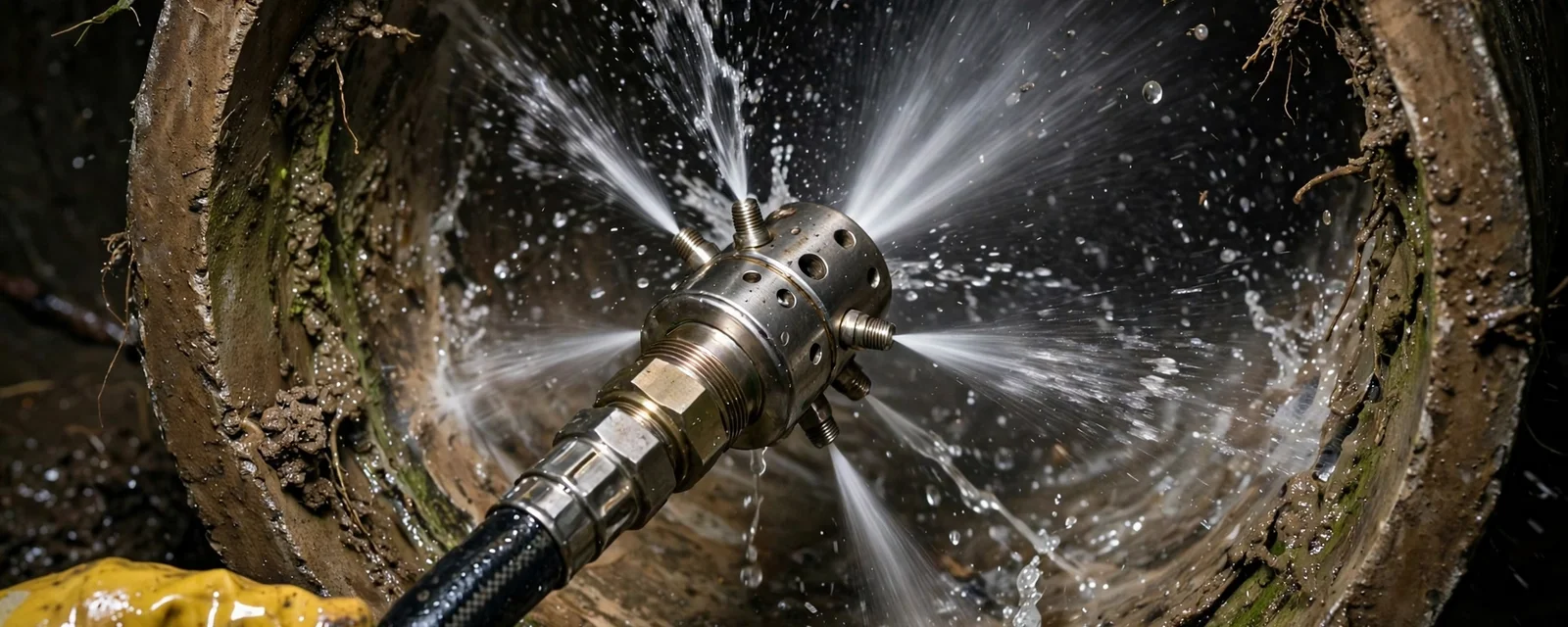
How a sewer line gets jetted
Find the cleanout
The plumber opens an access point on the sewer line, usually outside near the house or in the basement.
Run a camera first
A camera shows what blocks the line and what condition the pipe is in, before any pressure goes in.
Choose the nozzle
Different nozzles fit different jobs, such as a forward-facing tip to open a clog and a rear-facing tip to scour the wall.
Feed the hose and clear the line
Water flows at high pressure as the hose advances, then the plumber pulls it back to scour the pipe wall.
Camera again
A second look shows whether the pipe is clean and whether anything else needs attention.
What it clears, and what it does not
| Problem | Hydro jetting | Cable or snake |
|---|---|---|
| Grease coating the pipe wall | Scours the wall clean | Often punches a hole and leaves the coating |
| Soft roots entering at joints | Cuts and flushes small roots | Cuts a path, roots may grow back |
| Sludge and sediment | Flushes it out | May push it farther down |
| A single solid obstruction, such as a toy or rag | Can move it, but a cable or retrieval tool may fit better | Often the right tool |
| A cracked or collapsed pipe | Not the answer, and pressure may worsen it | Not the answer |
| Heavy roots through a broken joint | Clears them but the break remains | Same, the break remains |
EPA names fats, oils and grease, along with tree roots entering through defects in sewer lines, among the causes of blockages. Those are the two problems jetting handles best, because pressure scours a pipe wall. It does not fix the opening that let the roots in, so a clean line can still need a sewer line repair later.
When jetting is the wrong choice for an old pipe
High-pressure water is a good fit for a sound pipe and a risky choice for a damaged one. A pipe that is cracked, offset at a joint, collapsed, or very thin from age may break up or open further under pressure. Debris can also wash into a bad joint instead of out of the line.
- The camera shows a crack, a missing section, or a joint that has separated.
- The line has a belly, which is a low spot that holds water and waste.
- The pipe is crushed or partly collapsed.
- A previous liner or repair is peeling.
- The plumber cannot see the pipe, because no camera was run.
- The pipe's age and material are unknown and no one has looked.
If any of those apply, ask for another method, such as cabling, spot repair, or lining. A plumber who recommends jetting without footage is guessing. Our hydro jetting page covers the service, and a sewer inspection shows the pipe first.
Backing up now?
If drains are gurgling or sewage is coming up, stop using water and call. Dispatch is 24/7, and a licensed plumber will show you camera footage before any jetting.
What happens after the line is clean
A clean pipe is the start of the answer, not the end. If the cause was grease, changing what goes down the kitchen sink keeps the line clear longer. If the cause was roots, the footage should show where they entered so you can decide on a repair, a root treatment plan, or regular checks.
Ask for the after footage and keep it with your home records. It gives the next plumber, or the next buyer's inspector, a starting point. If the line clogs again soon after jetting, that is a signal to look for a bellied section or a break, not to jet again.
Signs your line may need jetting
Clogs that return
A cable clears it, then the same drain slows again in a few weeks.
More than one drain slow
Showers, tubs, and toilets slow together, which points to the main line.
Gurgling sounds
Air bubbling back through traps when water drains elsewhere.
Grease-heavy kitchens
Years of cooking residue may coat the line.
Roots near the line
Large trees near the lateral send roots toward joints.
Winslow Township: sewer or septic, and the 1970s housing stock
Jetting applies to the sewer line between your house and the public main, so first confirm you are on sewer. The Township's Department of Municipal Utilities (609-567-0700) handles sewer connections.
Its process runs through Camden County Municipal Utilities Authority (CCMUA) approval and a Township Construction Department permit, and the Township plumbing inspector must approve a connection before quarterly sewer billing starts. If your street is on septic, a septic contractor handles the tank and field and we handle the house plumbing.
Many Sicklerville homes were built by Levitt & Sons in the 1970s, in Winslow Crossing communities such as Primrose Gate, Manor Hall, and Arbor Meadows. We do not say what pipe any development used, because we have not verified it.
Practical tie-back: if your house is from that era, ask for the camera footage before any high-pressure work, because the pipe has had decades of service.
If the repair involves digging or replacing pipe, permit rules vary, so ask the Township Construction Office at 609-567-0700 option 5. The office decides what applies and keeps plumbing inspections Tuesday to Thursday, 8am to 1pm.
What to ask before you agree to jetting
- Can I see the camera footage before and after?
- Why is jetting the right method for this pipe?
- What pressure and nozzle will you use, and why?
- What happens if the footage shows damage?
- What is included in the price, and is the price clear before work starts?
- What is your plumbing license number?
Licensed plumbers show their license number on vehicles and advertising, and you can verify one with the State Board of Examiners of Master Plumbers at njconsumeraffairs.gov/plu. Jetting is also a call that covers 08081, 08095, 08018, and 08004 equally, since the pipe matters more than the ZIP code. We also serve nearby Gloucester Township and Berlin Borough.
Questions Winslow homeowners ask
It depends on the pipe. A camera has to show the pipe is sound first. Cracked, offset, collapsed, or very thin pipe may break or open further under high pressure.
For grease coating and sludge, jetting usually cleans more of the pipe wall. For a single solid object, a cable or retrieval tool may be the better tool. A camera look decides.
No. It clears roots from the pipe, but it does not close the opening where they entered. If roots return, the joint or crack may need repair.
Yes, we recommend it every time. It shows the pipe's condition and tells you whether jetting is safe. Footage afterward shows the result.
It depends on your street. Call the Department of Municipal Utilities at 609-567-0700 to confirm. If you are on septic, jetting does not apply to the tank, and a septic contractor handles the tank and field.
There is no set schedule. Some lines never need it, and others, such as grease-heavy or root-prone lines, may need cleaning from time to time. A camera look tells you if it is needed.
Sources and standards
Facts on this page come from these public sources. Check local rules with the office named in each.