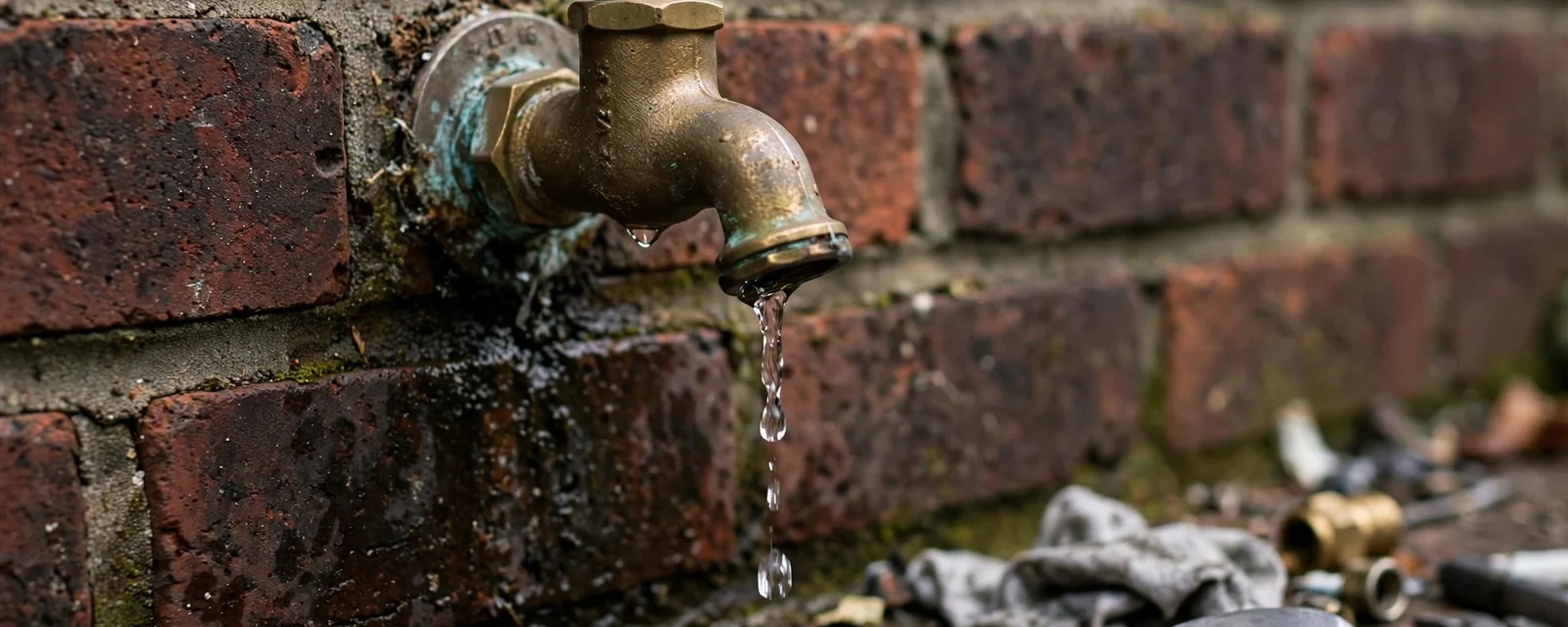
Where is the water coming from?
| Where it drips | Likely cause | DIY level | Next step |
|---|---|---|---|
| Out of the spout when closed | Worn washer or seat | Easy for most people | Shut off supply, replace the washer |
| Around the handle stem | Loose packing nut or worn packing | Easy | Snug the packing nut, then replace packing if needed |
| Where the pipe meets the wall | Cracked or loose pipe, failed seal | Call a plumber | Shut off the supply and inspect inside |
| Only when the hose is attached | Bad hose washer or hose | Easy | Replace the hose washer or hose |
| Wet drywall or floor inside near the spigot | Pipe cracked behind the wall | Call a plumber | Shut off the water supply to the house if it is active |
Fixes a careful homeowner can try
Turn off the supply to the outdoor faucet first. Some homes have a dedicated shutoff valve in the basement or crawlspace, often with a small bleeder cap. If you cannot find it, close the main shutoff and open the faucet to drain the line.
Disconnect the hose
A hose left on all winter is the number one reason spigots split. Remove it and any splitters before you work.
Tighten the packing nut
If water seeps around the handle stem, a quarter turn on the packing nut with a wrench often stops it. Do not overtighten, or the handle will bind.
Replace the washer
Unscrew the handle, remove the stem and swap the rubber washer at the end. Match the new one to the old in size and shape.
Check the seat
If the brass seat inside the body is pitted, a new washer will not seal. A plumber can replace the whole faucet.
Test and watch
Turn the water on, check the spout, stem and wall joint, and look at the inside wall near the pipe for stains.
Spring is the best time to test the outdoor faucet. Open it slowly with the hose off, watch the spout and the wall, and then check the room on the other side of the wall. A damp patch or a musty smell there means the pipe split over winter.
What freezing does to a spigot
Water expands as it freezes. If a standard faucet still holds water when the temperature drops, the ice can split the pipe behind the wall, even though the faucet looks fine outside. The leak then shows up in spring when the faucet is turned on, and water sprays inside the wall.
A frost-free faucet moves the shutoff deeper inside the house so the exposed part drains. It only works if it slopes slightly downward and if no hose is attached. A hose left on traps water in the barrel and defeats the design.
Do this before the first hard freeze
Remove every hose, close the interior shutoff to the outdoor faucet, open the outdoor spout to drain, and cover it with an insulated cap if the maker allows. In spring, turn it on slowly and check the inside wall.
Water coming from the wall?
Shut off the supply, keep electrical items away from wet areas, and call our 24/7 dispatch. Same-day appointments when available.
When a leaky spigot is not just a drip
If you notice a bill higher than normal, the leak may be bigger than it looks. The Township of Winslow notes that a higher water bill can mean an undetected leak, and a spigot left dripping through a hot summer can add to it.
Check for soft ground near the foundation, water stains in a finished basement, or a damp crawlspace wall.
Cracked pipe from a winter freeze belongs with burst pipe repair. A plumber can find the break, cut out the damaged section and replace it, and can tell you if the damage reaches further into the house.
What changes the cost of a spigot repair
A washer swap is a small job. A pipe repair behind a wall is not. These items move the quote.
Home policies typically pay for sudden damage, not for wear or neglect, so a freeze burst may be treated differently from a slow drip. Freeze damage claims depend on your policy, so ask your carrier before repairs and keep photos.
Winslow facts that affect your outdoor faucet
Your outdoor tap runs on Township water, which the Department of Municipal Utilities (609-567-0700) sources from ten wells in several aquifers and from New Jersey American Water. The DMU can send the annual water quality report, which has no hardness figure, so test your tap if mineral crust is eating your faucet seats.
If you live in Sicklerville (08081) or Cedar Brook (08018), check the age of your outdoor taps. Levitt-built houses in Sicklerville date from the 1970s, so spigots from the original builds may be decades old and due for a swap. If you are not sure when yours was last changed, plan to replace it rather than patch it again.
If a repair needs a permit decision, ask the Construction Office at 609-567-0700, option 5. The plumbing inspector is available Tuesday to Thursday, 8am to 1pm.
For a spigot that has outlived its washers, faucet repair and replacement is usually the better answer than another patch. We also serve Monroe Township in Gloucester County and Hammonton in Atlantic County.
Questions Winslow homeowners ask
A worn washer or pitted seat is the usual cause. Shut off the supply, take out the stem and replace the washer. If the seat is damaged, the faucet itself should be replaced.
Yes. The Township says a higher water bill can mean an undetected leak. A steady drip adds up over weeks, so fix it instead of waiting for the end of summer.
Signs include water spraying from the wall when you turn it on, a wet interior wall or ceiling near the spigot, and a faucet that will not shut off. Close the supply and call a plumber.
Removing the hose and shutting off the interior valve comes first. An insulated cap adds some protection, but it does not replace draining the line.
For work inside a wall, the Construction Office at 609-567-0700, option 5, is the place to ask, since its answer governs.
It reduces the risk when installed with a slight downward slope and when hoses are removed in winter. It does not help if the hose stays attached or the pipe has no slope.
Sources and standards
Facts on this page come from these public sources. Check local rules with the office named in each.