Why is my yard wet and my pressure low?
A soggy strip of lawn, a dip in the driveway or a faucet that now dribbles are the signs most people notice first. They often come from the same cause, a break in the buried line that feeds the house. The technical name is a water service line leak, and finding it comes before any digging.
Where your responsibility starts and the utility's ends
In general, the utility owns the main in the street and the connection to it, and the homeowner owns the pipe from there to the house. Ownership can differ by street and by utility, so confirm yours. Winslow Township's Dept. of Municipal Utilities can be reached at 609-567-0700 on weekdays, 8:30 to 4:30.
The Township's system buys water through an interconnection with New Jersey American Water, in addition to drawing from its own wells. Which supplier serves your street does not change who fixes a break on your side of the line, but it does decide who you call about the meter. We do not work on utility-owned equipment.
| Problem | Usually handled by | Why |
|---|---|---|
| Leak in the street main | The water utility | The main is utility property |
| Leak at the meter or its fitting | The water utility first | The meter belongs to the utility |
| Leak between the meter and the house | A licensed plumber | The service line is generally the homeowner's pipe |
| Leak inside the house after the main valve | A licensed plumber | Interior piping is yours |
| Low pressure in the whole street | The water utility | Check with neighbors first |
Water service line leak: how we find and fix it
Confirm it is the service line
We close the house valve and watch the meter. Motion with the house valve closed puts the leak outside.
Locate the break
We use pressure testing and listening gear to narrow the leak to a short stretch before any digging.
Choose the repair
A short cut-in repair, a longer replacement run or a trenchless route if the layout allows it.
Restore and test
We test the new section under pressure, then close the trench, and flag permit steps with the Construction Office.
Trenchless replacement pulls or bursts a new pipe through the old path with fewer holes. It does not suit every property, so we tell you when open trenching is the better choice. Where the pipe is old across its whole length, a full run may make more sense than another spot patch.
Low water pressure: a leak, a valve or something else
Low pressure is not always a line leak. A partly closed valve, a clogged aerator or a failing pressure regulator can all cause it. If only one faucet is weak, it is likely local to that fixture. If every fixture drops at once, we look at the main valve, the regulator and the service line.
A sudden drop with a wet yard points to a break. A slow decline over months suggests corrosion or mineral buildup inside older pipe. We do not state a hardness level for the Township supply, and we suggest testing your own tap if scale is a worry.
Meter and curb box notes
The curb box is the small lid near the street that covers the shutoff valve. If it is buried, cracked or crowded with leaves, finding the valve in an emergency wastes time. Photograph it now and clear it, but do not turn a utility valve unless the utility tells you to.
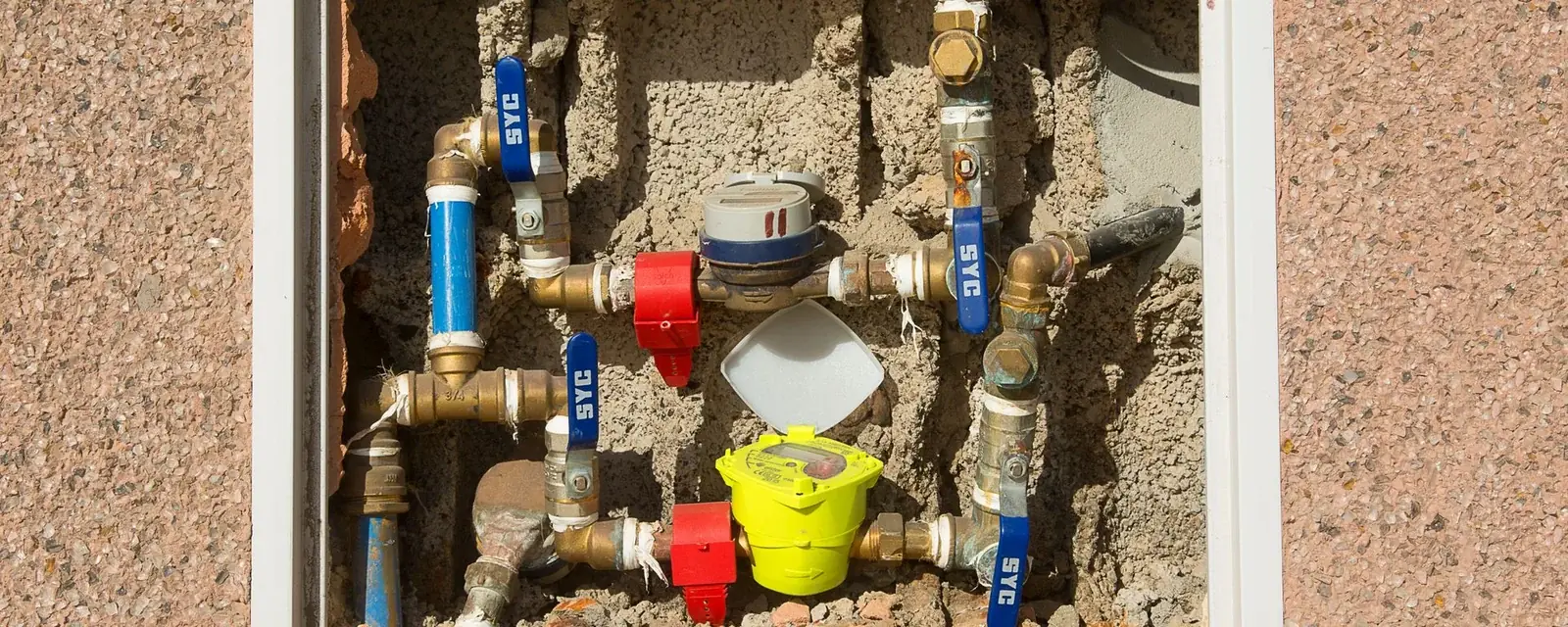
A meter box full of water is a signal worth reporting. The seep may be at the meter or just past it, and we can tell the difference with a pressure test. If the meter or its connections are the cause, the DMU takes it from there.
Know the line is leaking?
Call (609) 547-1417. We dispatch 24/7 and book same-day appointments when available. Close the main first if it is safe to do so.
Leaking water outside: what to do while you wait
Before the technician arrives
Close the house main
Turn the valve inside the house clockwise until it stops. Leave the curb valve alone.
Stop using water
No laundry, dishwasher or showers. Flush only if needed.
Mark the wet area
Place a cone, chair or stake where the ground is wettest. Keep children and pets back.
Check the meter
Snap a photo of the dial with the house valve closed.
What Winslow's ground and housing mean for water lines
Winslow Township sits in the Pinelands region, with about 80 percent inside the Pinelands National Reserve. The aquifer under it is described by the state as a water-table system that follows rainfall. After a wet week a lawn can stay soft for reasons that have nothing to do with the pipe, so we test before we dig.
Sicklerville's 1970s Levitt-built neighborhoods now have service lines that are fifty years or more old. That does not mean a line is bad. It does mean that a lawn patch in 08081 that stays wet in dry weather deserves a pressure test, and the same goes for older homes in 08095, 08018, 08004 and 08037.
Pressure testing, then repair or replace
Many service line jobs end in a choice between repairing a short section and replacing the run. Repair is quicker when the pipe is sound everywhere else. Replacement is better when we find several weak spots, because each fix leaves older pipe on both sides under stress.
When the damage is wider than one pipe, such as a fixture line inside the house, our leak detection work covers the interior search. For a house-wide pipe replacement, see our repiping page. Nearby towns we serve, like Berlin Borough, are listed on our Berlin page.
What changes the price of a water line repair
You get a clear price before work starts. These are the factors that move it.
Homeowners insurance typically responds to sudden damage and not to wear or neglect, and many policies treat buried-line failure as wear. Ask your carrier before work starts.
Water Line Repair questions in Winslow, NJ
Yes. Dispatch is 24/7, including nights and weekends. Close the house main, stop using water and call. We do not promise an arrival time, and we give you a price before work begins.
It might be. A sudden drop with a wet spot in the yard points to a break. If only one faucet is weak, the cause is probably that fixture or a valve.
Generally the homeowner owns the pipe from the meter to the house, but it varies. Call the Township DMU at 609-567-0700 on weekdays to confirm for your street.
Permit rules vary, so ask the Construction Office at 609-567-0700 option 5. They decide, and we flag the question before work starts.
Sometimes. Trenchless methods use small access pits, but they depend on the layout and soil conditions. We explain what fits your property.
Close the house valve and watch the meter. If it still moves, the loss is outside. If it stops, the leak is in the house.
Sources and standards
Facts on this page come from these public sources. Check local rules with the office named in each.