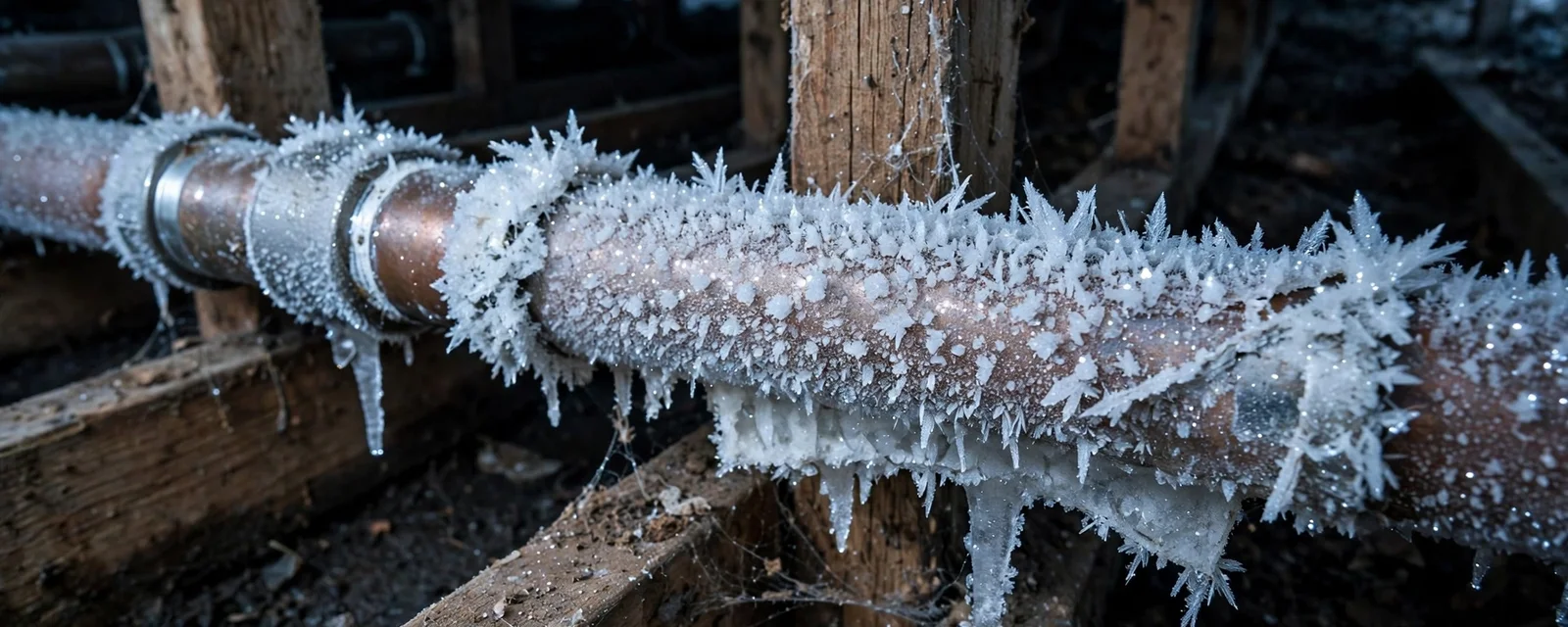
Signs a pipe has frozen
- A faucet gives only a trickle, or nothing, while others in the house work.
- Frost shows on a pipe that runs along an exterior wall.
- A pipe in a crawl space, garage, or basement corner feels very cold or has ice on it.
- You hear no water hissing when the faucet is open, and no flow.
- A dripping or bulging pipe shows it may have split already.
The American Red Cross says likely places for frozen pipes include against exterior walls or where your water service enters the home through the foundation. If one pipe has frozen, others may too, so check every faucet in the house.
How to thaw a frozen pipe safely
Keep the faucet open
Water will begin to flow as the ice melts, and moving water helps melt more ice.
Find the frozen section
Start at the faucet that gave the trickle and follow the pipe toward the cold spot.
Apply gentle heat
Use an electric heating pad wrapped around the pipe, an electric hair dryer, or towels soaked in hot water. A space heater can be used if it is kept well away from anything flammable.
Keep applying heat until the flow is normal
Stay with it until full water pressure is back.
Check the rest of the house
Test every other faucet in case more pipes froze.
Never use open flame
Do not use a blowtorch, a kerosene or propane heater, a charcoal stove, or any open flame on a frozen pipe. Flame can ignite insulation or framing and can damage the pipe. If you cannot find the frozen area, cannot reach it, or cannot thaw it, call a licensed plumber.
What to do if a pipe has already split
If you see water spraying, dripping from a ceiling, or pooling, shut off the main water valve right away. Turn off power to any wet area before you step into it, and move belongings away from the water. Open the lowest faucet to drain the line.
A split pipe often shows up only after the ice melts, because the ice was holding the crack closed. That is why a pipe that thawed on its own can still leak an hour later. If you ever notice a wet spot after a freeze, close the main and call a plumber who handles burst pipe repair.
Pipe split or water coming through the ceiling?
Shut off the main and call. Dispatch is 24/7, and a licensed plumber will give a clear price before work starts.
Cold-weather prevention for a Winslow house
| Location | Why it freezes | What helps |
|---|---|---|
| Exterior walls | Cold passes through the wall to the pipe | Open cabinet doors under sinks, insulate, let a faucet drip in very cold weather |
| Crawl spaces and basement corners | Little heat reaches them | Add insulation and use pipe sleeves |
| Garages | Doors let in cold air | Keep the garage door closed if water lines run through it |
| Outdoor hose bibs | Water left in the pipe or hose | Remove hoses, close the inside valve, open the outside spigot to drain |
| Unheated attics | Cold air above the insulation | Insulate hot and cold pipes, and check around the home for supply lines in unheated areas |
| A house left empty | No heat running | Leave the heat on, set no lower than 55 degrees |
The Red Cross also advises keeping the thermostat at the same temperature day and night during very cold weather. It may raise your heating bill, but it can prevent a more costly repair if pipes freeze and burst. UL-listed heat tape or heat cable on exposed pipes is another option, and the manufacturer's instructions should be followed closely.
Winslow Township: water service, shutoffs, and permits
The Township's Department of Municipal Utilities (609-567-0700) is the office to call about the water service that serves your house.
The Township's water comes from wells and from an interconnection with New Jersey American Water, so a freeze that affects the street is a different problem from a freeze inside your walls. If water is out for your neighbors as well, call the DMU first.
Practical tie-back: find your main shutoff valve before the cold arrives. In many houses it sits where the water service enters through the basement or crawl space wall, which the Red Cross names as a likely place for freezing.
Label the valve, make sure everyone in the house can reach it, and ask the DMU what to do about the curb-side shutoff.
Pipe repair after a freeze can involve cutting into walls or replacing sections. Permit rules vary, so ask the Township Construction Office at 609-567-0700 option 5, and remember that plumbing inspections run Tuesday to Thursday, 8am to 1pm.
Many Sicklerville homes date to the 1970s Levitt era, and homes of that age may have pipes in exterior walls or slab edges, so check those areas first when the thermometer drops.
When to stop and call
Call a licensed plumber if you cannot find the frozen section, if the pipe is inside a wall or under a floor, if you see a crack or bulge, or if the thawed pipe leaks.
A plumber can also check for hidden damage that shows up later, and water line repair may be needed if the frozen pipe is the service line outside the house.
We dispatch around the clock to Winslow addresses in 08081, 08095, 08018, 08004, and 08037, and to neighboring Hammonton in Atlantic County and Monroe Township in Gloucester County. We do not diagnose boilers or furnaces on this page. If your heat has failed, call a heating contractor and keep water running at a trickle until the house warms.
Questions Winslow homeowners ask
A frozen pipe usually affects the water supply, so a faucet gives a trickle or nothing in cold weather. A clog affects drainage, so water backs up in the sink or tub. A faucet that runs only a trickle in a freeze is the classic sign.
Yes, an electric hair dryer is one of the safe heat sources the Red Cross lists, along with a heating pad and towels soaked in hot water. Keep the faucet open while you do it, and never use a blowtorch or open flame.
Running water through a pipe, even at a trickle, helps prevent freezing. Choose the faucets on exposed pipes, such as those on exterior walls. Let the cold water drip, and open the cabinet doors under the sink.
Insurance typically responds to sudden damage and not to wear or neglect, but policies differ. Ask your carrier before you start repairs, and take photos of the damage.
Shut off the main water valve before you go inside if you can see signs of leaking. If the house is dry, open faucets slowly and check every fixture. Call a plumber if you see wet ceilings, damp walls, or a pipe that will not thaw.
The Red Cross advises leaving the heat on, set no lower than 55 degrees, if you will be away during cold weather. Open cabinet doors under sinks on exterior walls as well.
Sources and standards
Facts on this page come from these public sources. Check local rules with the office named in each.